
How to Find Recently Released Palm Beach County Inmates
Start with the PBSO Booking Blotter. It covers current custody and people booked within the visible one-year window, so a recent booking that no longer shows as in custody can point to a release. The blotter is not labeled as a release list, so it confirms a release only by what it does and does not show. For a firm answer, call PBSO Inmate Records at (561) 688-4340.
Release from the county jail happens after bond is received, processed, and executed. PBSO says inmates are released from the Main Detention Center through the Visitor's Lobby or from the West Detention Center. Online systems can lag, so for urgent verification, call the facility or Inmate Records rather than relying on a screen.
A release does not close the criminal case. The person may still have future court dates in the Clerk's eCaseView system. Search by name or case number to check.
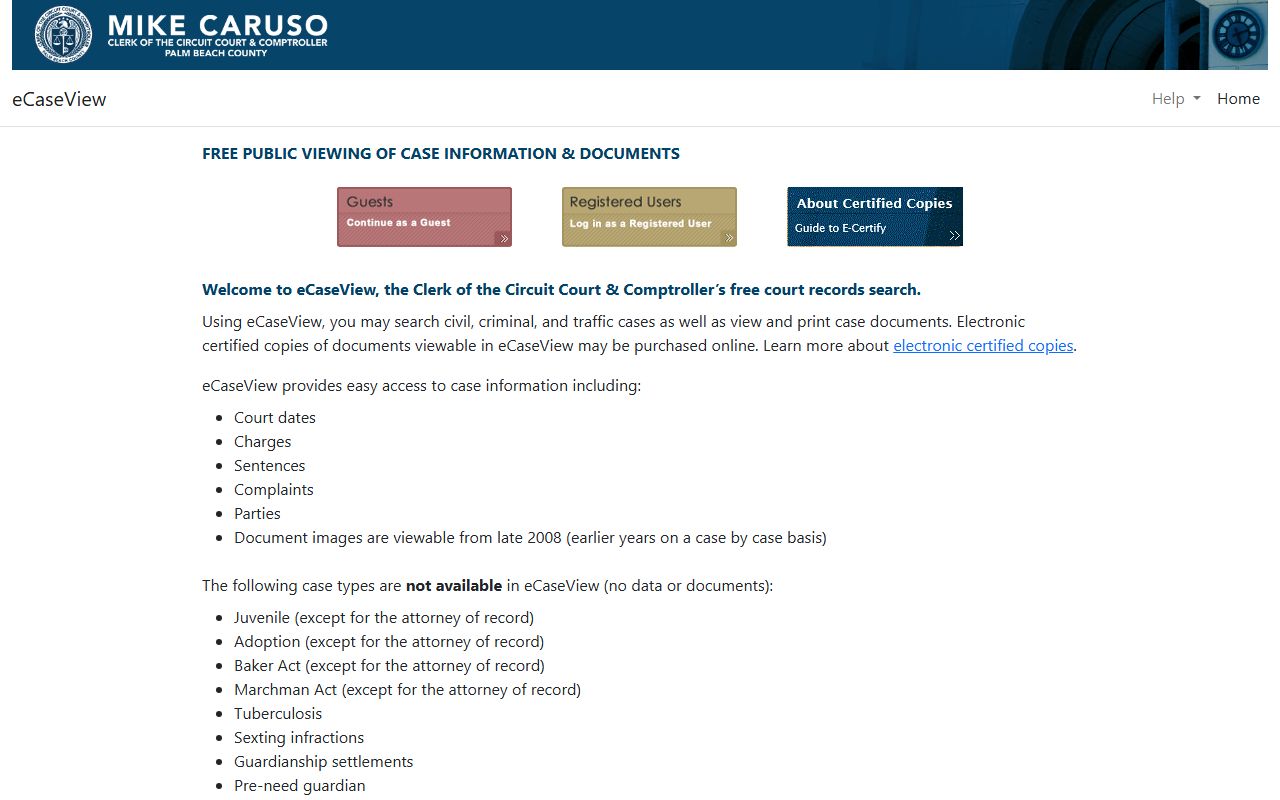
The eCaseView search screen shown above is where a released person's pending court dates and case status can still be tracked after they leave jail.
Setting Up Release Notifications
VINELink is a victim notification and custody status service available at vinelink.com. It lets a person register for an alert when an offender's custody status changes. Participation varies by state, county, and agency, so a VINELink alert is a helpful backup, not a guarantee. Keep contact data current and still verify a critical release directly with the jail.
- Visit VINELink and select Florida or the participating agency area.
- Search by offender name or ID where the state supports it.
- Register a phone, email, or text contact to receive custody status alerts.
Searching the Florida Department of Corrections
When a person is sentenced to state prison, they leave county custody and enter the Florida Department of Corrections. The FDC offender search covers state prison inmates and people on state supervision, with menus for inmate population, inmate release, supervised population, and absconders. It is not county jail data, so use it for anyone who moved on to a state sentence.
| Field Label | Type | Required | Notes |
|---|---|---|---|
| DC Number | Text | No | Most precise state prison identifier |
| Last Name | Text | No | Name search |
| First Name | Text | No | Name search |
| Search Category | Menu | No | Population, release, supervision, absconder |
Federal Bureau of Prisons Locator
Federal custody is separate again. The BOP Inmate Locator covers federal inmates from 1982 forward and returns release status and facility. Use it for anyone sentenced in a federal case, such as a matter from the Southern District of Florida.
| Field Label | Type | Required | Notes |
|---|---|---|---|
| BOP Register Number | Text | No | Exact federal identifier |
| Last Name | Text | For name search | Required when searching by name |
| First / Middle Name | Text | No | Narrows a name search |
| Race / Sex / Age | Dropdown | No | Optional narrowing fields |
Verifying Release in Person or By Phone
The fastest way to confirm a county release is a phone call. PBSO Inmate Records answers at (561) 688-4340, and the Main Detention Center main line is (561) 688-4401. The West Detention Center can be reached at (561) 712-2971. When an inmate is released or transferred, PBSO says personal property and any account balance are released or transferred as well. If the online tools disagree with what staff tell you, trust the direct contact, since the systems can lag behind the actual event.
An in-person visit to a facility lobby can also confirm a release, though a phone call is usually faster and saves a trip. Have the person's full booked name and, if possible, the jacket number ready before you call. Staff cannot always predict an exact release time, because bond processing, paperwork, and any holds from another agency all affect when a person actually walks out.
Bond and the Release Process
Most county releases happen through bond. PBSO accepts a cash bond by cash, money order, or certified check only, with no personal checks, made payable to Palm Beach County Sheriff. Once the bond is received, processed, and executed, the jail releases the person. The actual walk-out can trail a judge's order by hours, because the jail still has to finish processing. That gap is why a court record may show release conditions before the booking blotter updates.
A court release and a jail release are two events. A judge may set bond or order release at a first appearance, but custody continues until the jail completes the steps. For the underlying case status, search the Palm Beach County court records portal, since the case stays open even after the person leaves the jail.
Property and Money After Release
When an inmate is released or transferred from PBSO custody, the agency says personal property and any account balance are released or transferred as well. Money deposited into a commissary account can be subject to collection for debts owed to the jail, including bond money. An account balance over $10,000 triggers IRS reporting. Families with questions about a released person's funds or property should contact the facility that held them, since the Main Detention Center and the West Detention Center handle their own release lobbies.
Florida Sex Offender Registry
A person with a qualifying conviction may have a registration duty after release. The FDLE Sexual Offenders and Predators Search is the statewide public registry. FDLE notes the data is public record offered to help citizens stay aware, but placement is not a risk-level rating, and positive identification needs fingerprints. Misuse of registry information is illegal under Florida law.
| Field Label | Type | Required | Notes |
|---|---|---|---|
| Name Search | Text | No | Public registry name entry |
| Geographic Search | Text | No | Address or area registry search |
| Employment Address File | Link | No | Separate registered employment address data |
Parole and Probation Information
Most release supervision in Florida runs through the Florida Department of Corrections, which manages probation, parole, and community supervision. Florida largely ended parole for offenses committed after the early 1980s, so most supervised release today is probation or community control. A released person on supervision who is alleged to violate can face a violation report and a warrant, which then shows in the court case. Defendants who need counsel after release can turn to the Public Defender for the Fifteenth Judicial Circuit.
Public Defender, 15th Judicial Circuit
Serving Palm Beach County
West Palm Beach, FL
Indigent defense office
The Public Defender's office shown above represents eligible released defendants who still face open charges or a supervision violation.
Reentry Resources in Palm Beach County
The West Detention Center provides reentry services through community partners for inmates returning to the community, alongside drug education, religious services, and self-improvement programs. After release, civil legal needs often follow, from housing to family matters. Several organizations help eligible low-income county residents.
- Legal Aid Society of Palm Beach County - civil legal aid for eligible county residents.
- Florida Rural Legal Services - legal aid for low-income clients, including rural communities.
- Florida Law Help - statewide legal information and referrals.
Q: Does release from jail end the case?
No. A release from county custody does not close the criminal case. The person may still have hearings, probation reporting, or a disposition pending in eCaseView. Always check the court record by name or case number after a release, since a missed future date can lead to a new warrant.
Civil Rights Restoration After Release
Restoration of civil rights after a felony conviction is handled through Florida's clemency process and constitutional rules, not by the Clerk or PBSO. Because the rules are specific and can change, this page does not promise automatic restoration of voting or firearm rights. A released person should use official state clemency and voter resources to confirm current eligibility. A released person may also still appear in the Florida DOC system if later sentenced to prison, in the BOP if federally sentenced, or in the FDLE registry if a registration duty applies.