
Arrest Records in Palm Beach County
The Palm Beach County Sheriff's Office is the main source of arrest records in the county. When deputies or a local police department book a person into custody, PBSO records the booking, the charges, and identifying data. PBSO is the largest law enforcement agency in the county, led by Sheriff Ric L. Bradshaw since January 2005. The agency lists 4,464 total staff and runs two detention centers, so most county arrests flow through its system.
An arrest record is not a conviction. The booking shows that a person was taken into custody on a charge. What happened next, the plea, the disposition, and any sentence, lives in the criminal court file kept by the Clerk. For the full case history, the Palm Beach County court records portal is the right tool. This page focuses on finding the arrest and reading it correctly.
The PBSO home page, shown above, links the arrest and jail tools that hold county booking data and current custody records.
How to Search Palm Beach County Arrest Records
The official arrest search is the PBSO Booking Blotter. It covers people currently in custody in PBSO facilities and anyone booked within the visible one-year window. You can search by date range, name, street, city, statute, and arresting agency. A search submission requires a captcha check.
- Open the PBSO Booking Blotter and set a start and end date within the past year.
- Add a last name and first name, or leave the name blank for a date-only search of 31 days or less.
- Narrow by arresting agency if you know which department made the arrest.
- Complete the captcha and review the booking results.
The arresting agency dropdown is long because the county has many police departments. Besides PBSO, it lists agencies for West Palm Beach, Boca Raton, Boynton Beach, Delray Beach, Jupiter, Palm Beach Gardens, Riviera Beach, and dozens of smaller municipalities, plus Florida Highway Patrol troops. If a date-only search returns too much, add a name or pick the agency that made the arrest. The date span for a no-filter search is capped at 31 days.
For statewide criminal history, the Florida Department of Law Enforcement keeps the official record. State prison data is searchable through the Florida Department of Corrections offender search, and federal custody runs through the BOP Inmate Locator.
Arrest Records vs. Criminal Court Records
An arrest record starts at booking. A criminal court record starts when the State Attorney files charges. They are kept by different offices and answer different questions. The arrest record shows who was booked and on what charge. The court record shows how the case moved and how it ended.
| Arrest Record | Criminal Court Record | |
|---|---|---|
| Source | PBSO / local police | Clerk of the Circuit Court |
| Created When | At booking | When charges are filed |
| Contents | Booking data, charges, mugshot | Pleadings, motions, disposition, sentence |
| Where to Search | PBSO Booking Blotter | eCaseView |
The booking blotter warns that its information should not be relied upon for any type of legal action and that identity can only be confirmed by fingerprint comparison. Arrest and court data should be read together, not in isolation.
Charges vs. Convictions
Being charged is not the same as being convicted. A charge is the state's accusation, supported by probable cause. A conviction comes only after a plea or a verdict that meets the higher beyond-a-reasonable-doubt standard. In Florida, a court can also withhold adjudication, which means it found facts to support guilt but did not enter a formal conviction. Reading only the charge line gives a false picture.
| Charge | Conviction | |
|---|---|---|
| Stage | Accusation at arrest or filing | Verdict or guilty plea |
| Burden of Proof | Probable cause | Beyond a reasonable doubt |
| Public Record | Yes | Yes, unless sealed or expunged |
Sealed vs. Expunged Records
Florida treats sealing and expunction as two different remedies. Sealing under Florida Statutes § 943.059 hides a record from ordinary public view while letting certain criminal justice and licensing agencies still see it. Expunction under Florida Statutes § 943.0585 goes further and removes the record from general access. Both require a Certificate of Eligibility from the Florida Department of Law Enforcement before a court petition.
| Sealed | Expunged | |
|---|---|---|
| Visibility | Hidden from public view | Removed from public access |
| Law Enforcement | Some agencies retain access | Very limited access |
| Eligibility | FDLE Certificate, no disqualifying record | FDLE Certificate, stricter criteria |
The Clerk's fee to seal or expunge any record is $42. Many offenses and dispositions do not qualify, so the eligibility step is where most petitions succeed or fail. The FDLE sealing and expunction FAQ walks through the process.
Mugshots and Booking Photos
Booking photos in Palm Beach County are part of the PBSO booking record and are searchable through the official Booking Blotter, subject to the agency's accuracy warnings. The Sheriff's office, led by Sheriff Ric L. Bradshaw, controls how booking data is published. Use the official PBSO source rather than reposting booking images, and remember that a booking photo reflects an arrest, not a conviction.
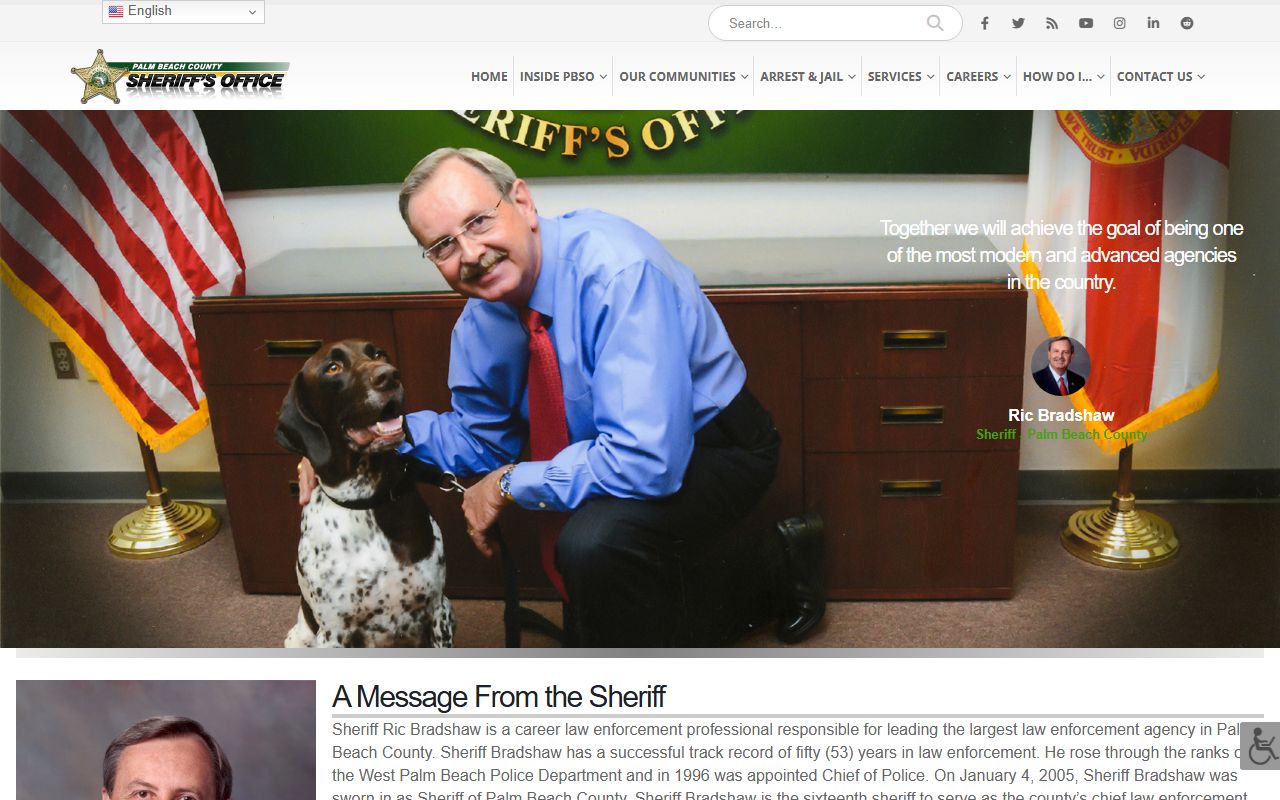
The official Sheriff Ric Bradshaw page, pictured above, confirms the agency leadership that oversees county booking and corrections records.
Statewide Criminal Records Search
A county booking search shows local arrests, but a full criminal history is a statewide record. The Florida Department of Law Enforcement is the state custodian of criminal history information. For people sentenced to state prison, the Florida Department of Corrections offender search returns custody and supervision data. PBSO's general facts page describes the scale of the agency that feeds much of the county's arrest data into these systems.
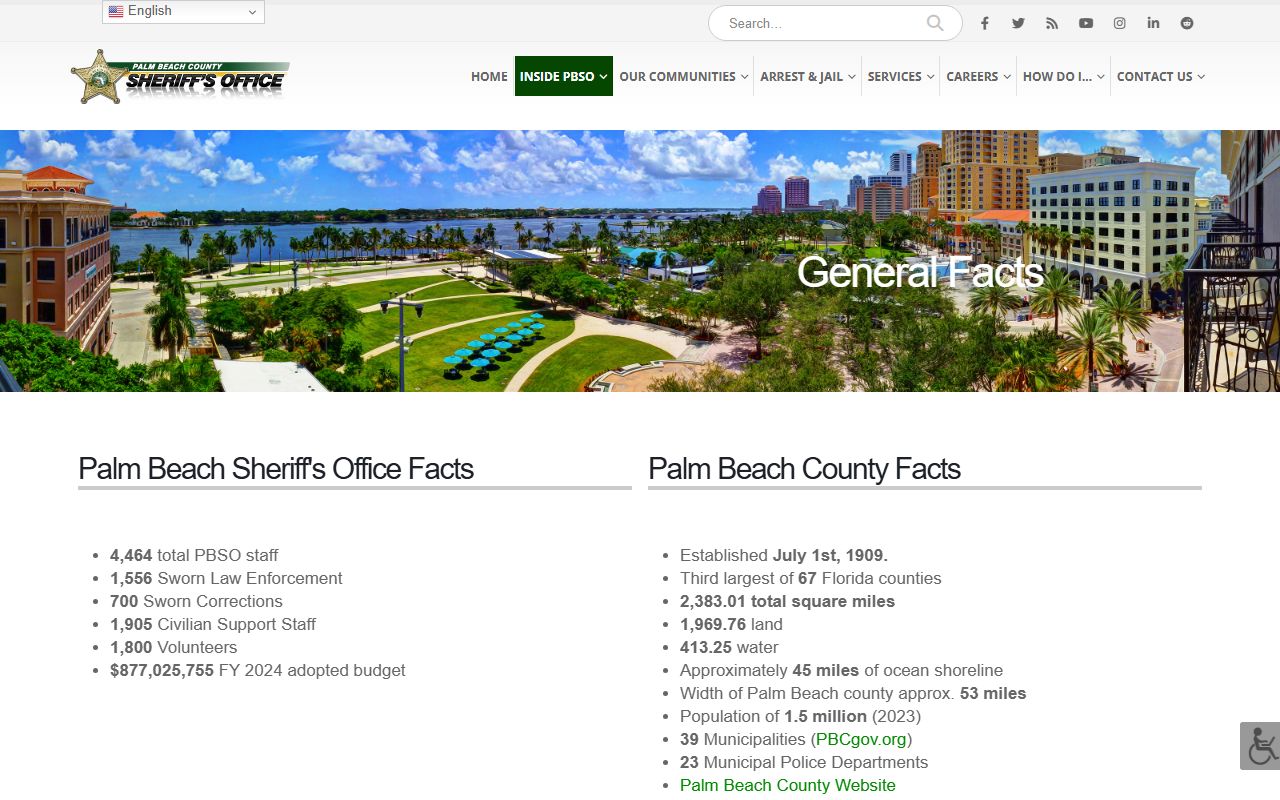
The PBSO facts page shown here lists the staffing and budget behind the agency that books and houses county arrestees.
Background Check Considerations
A casual arrest lookup is not a legal background check. Employment, tenant, and credit screening must follow the federal Fair Credit Reporting Act and use a licensed consumer reporting agency. Free public booking and court searches are fine for personal awareness, but they are not built to FCRA standards and can be incomplete or out of date.
Important: This site is not a consumer reporting agency under the FCRA, and its information cannot be used for employment, tenant, credit, or insurance decisions.
What a Palm Beach County Booking Record Shows
A booking record packs a snapshot of the arrest. The exact fields vary, but a PBSO booking entry generally carries the items below. The court file fills in the rest of the story over time.
| Field | What It Shows |
|---|---|
| Booked Name | The name used at booking, plus any aliases on file. |
| Booking Date / Number | When the person was booked and the jacket or booking number. |
| Charges / Statute | The arrest charges and the Florida statute cited. |
| Arresting Agency | PBSO or the local police department that made the arrest. |
| Bond | The bond amount or a no-bond status where it applies. |
| Facility / Status | Where the person is held and whether they remain in custody. |
Note: PBSO cautions that a booking record is not proof of guilt and that true identity can only be confirmed by fingerprint comparison.
Who Prosecutes and Defends Criminal Cases
After an arrest, the case moves to the State Attorney for the Fifteenth Judicial Circuit, the elected prosecutor for Palm Beach County. The State Attorney decides what charges to file, which can differ from the arrest charges. The official prosecutor site is the State Attorney, Fifteenth Judicial Circuit.
Defendants who cannot afford a lawyer can apply for the Public Defender for the Fifteenth Judicial Circuit. The court appoints the Public Defender or conflict counsel after an indigency review. Both offices work cases that begin with a PBSO arrest and end with a disposition in the Clerk's criminal court file.
Restricted Criminal Records in Palm Beach County
Some criminal records stay out of public view. Juvenile justice information is confidential under Florida Statutes § 985.04, so most juvenile arrests do not appear in the public court portal. Sealed and expunged records are removed or hidden by court order. Ongoing investigation material can be exempt while a case is active. For traffic-related arrests such as DUI, the case routes into criminal court, and the traffic court records page covers that overlap.